
Englisch



Welcome to the homepage section of the English department at Gymnasium Bern Neufeld. English can be studied as a basic subject (Grundlagenfach) or as an optional course (Fakultativfach), and as a core subject (Schwerpunktfach) at our school. We hope that the information below gives you an idea of what to expect if you or people you know are thinking of doing their matura or their FMS diploma at Gymnasium Neufeld. Students who already go to our school–and others–might find the link section as well as the examples of excellent matura papers in English helpful. E-mail addresses of our English teachers can be found in the staff section.


Grundlagenfach
Grundlagenfach & Fakultativfach
English is the most widely spoken global language and the world’s favourite lingua franca. In our era of highly increased economic, political, and cultural interconnectedness, a strong command of English is essential for students‘ academic, professional, and social life after Gymnasium.
At our school, English is taught as a „Grundlagenfach“ for 3.5 lessons per week in GYM1, 3 lessons per week in GYM2 and GYM3, and 2.5 lessons per week in the last year of Gymnasium. Students choosing English as an optional course („Fakultativfach“) participate in the same lessons. Up-to-date teaching materials and modern infrastructure contribute to effective learning.
English at Gymnasium is more than just a language course: Apart from grammar and vocabulary – engaging with literary and other cultural subject matter, as well as the use of digital sources, newspapers, film, television, and radio allow our students to profit from a broad language education during which they develop the four core language skills—speaking, writing, reading, and listening—on an advanced level.
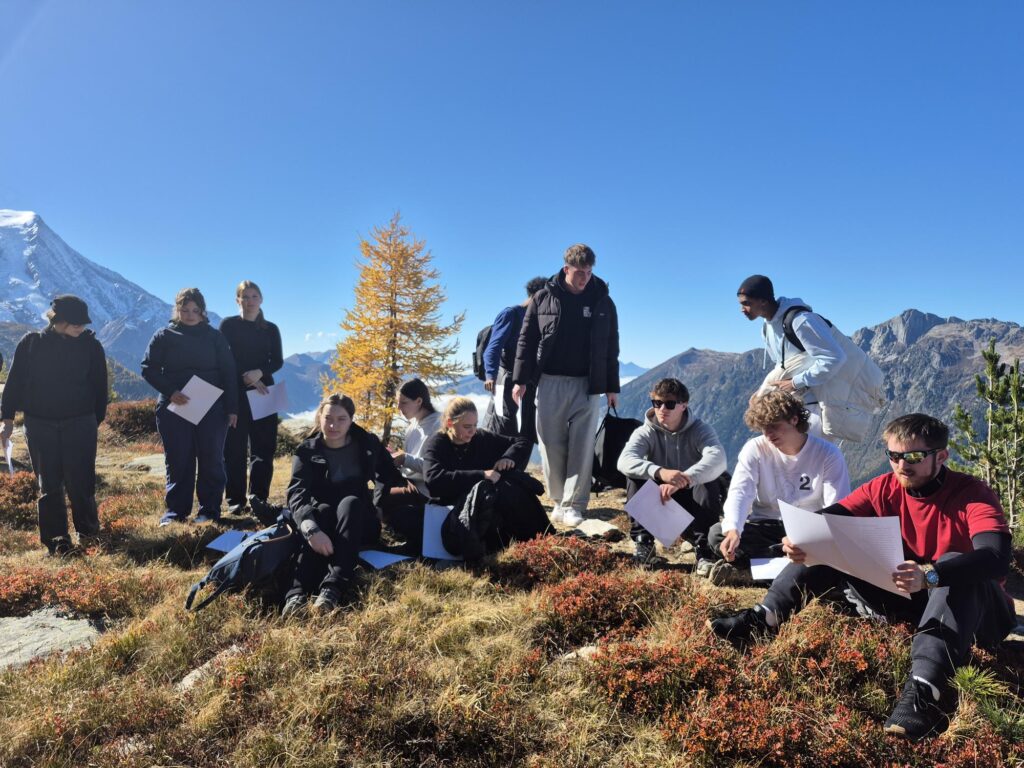
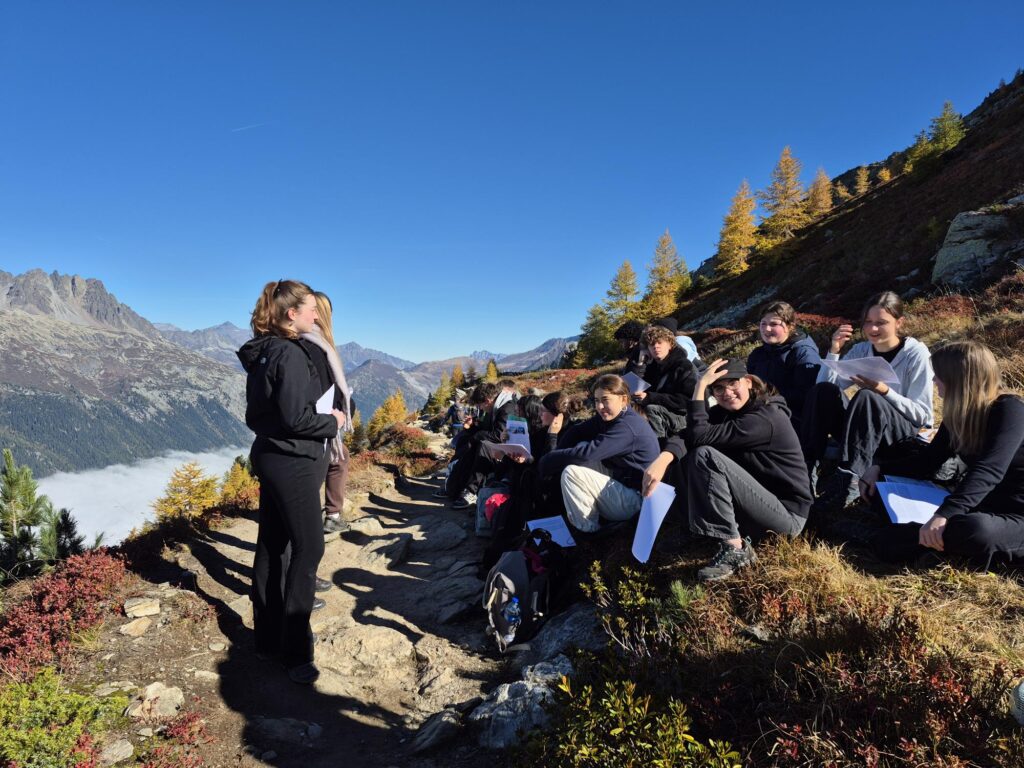
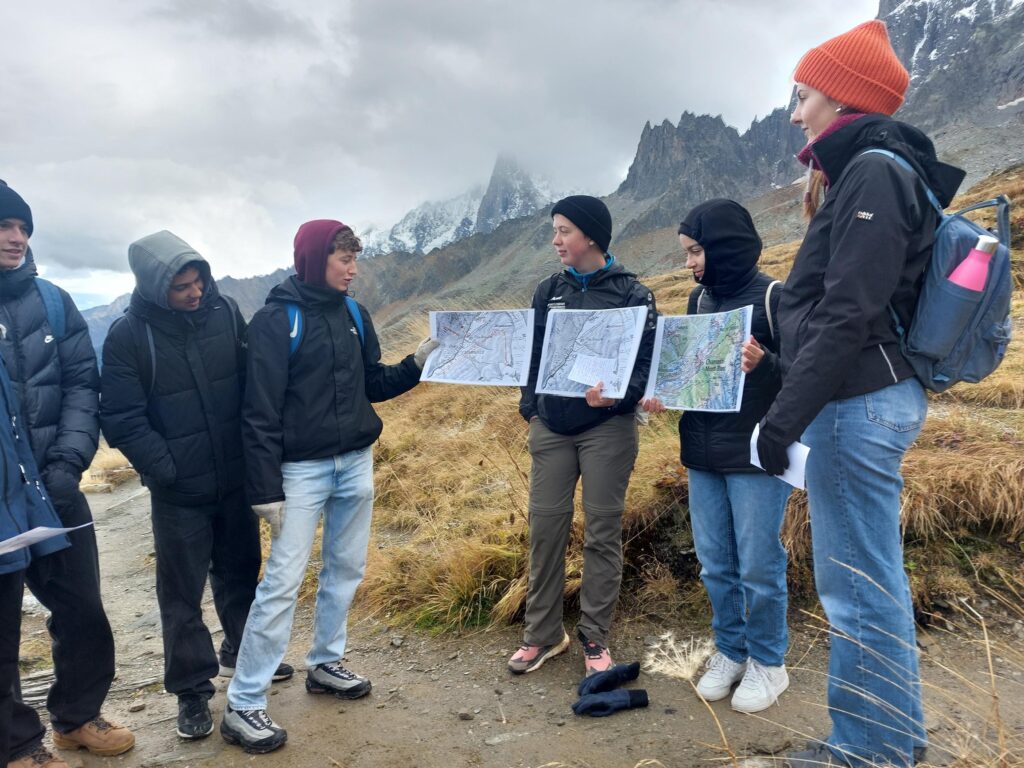



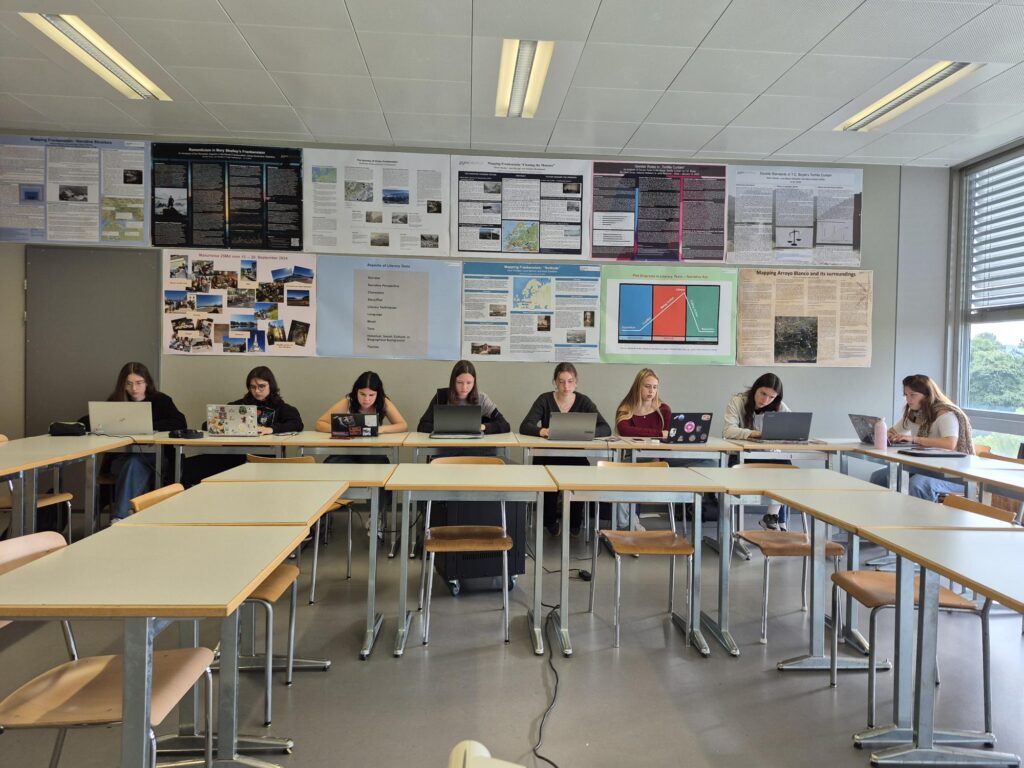
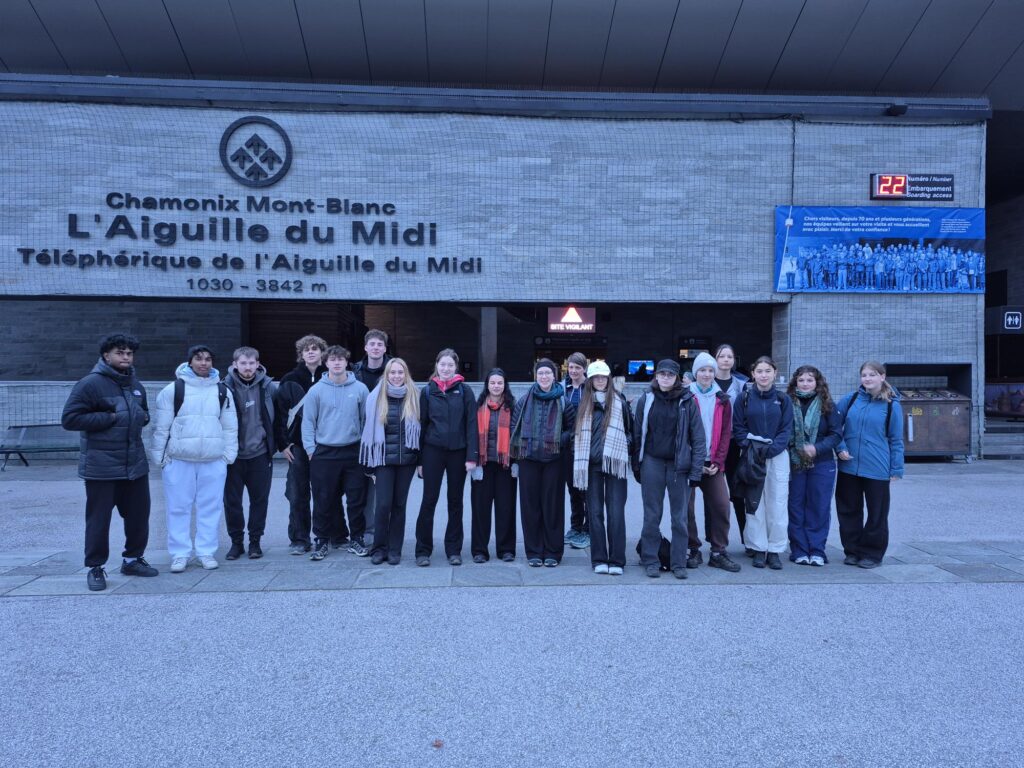
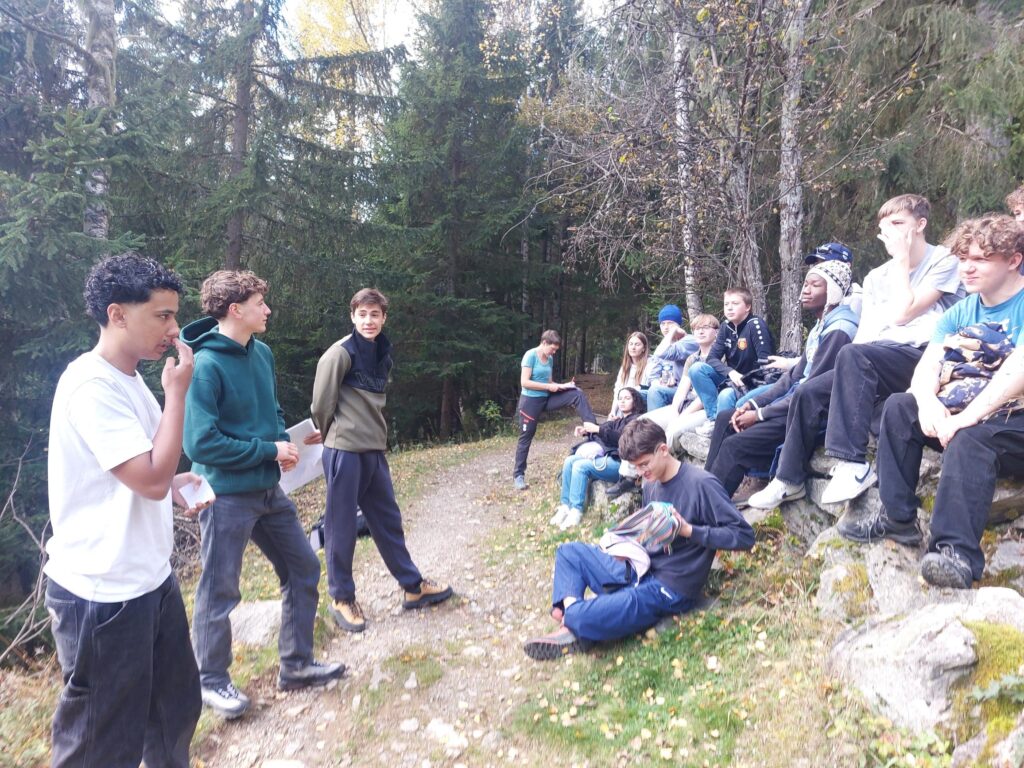
Interdisciplinary sequence connecting Geography and English Pictures from our 2025 and 2026 trips to the Chamonix Valley with GYM4 classes
Schwerpunktfach
Schwerpunktfach
In this specialized four-year course, English is taught in a total of 14 weekly lessons (3 in GYM1 and GYM2 / 4 in GYM3 and GYM4). More focus and in-depth work is attributed to the English language as a cultural means. More time is devoted to project work and to different literatures of the English-speaking world. More attention might be given to linguistic nuances in students‘ spoken and written expression as well as to their individual fields of interest.




2024 London week with our „Schwerpunktfach“ course
Cambridge Language Certificates
Cambridge Language Certificates
For the last twenty years, Gymnasium Neufeld has been preparing groups of students for the Cambridge Exam in Proficiency in English (CPE). It has been running two preparatory elective courses with roughly 12 students each. The classes take place in the second semester of GYM3 and go on through the first semester GYM4.
Since this elective is both very popular and in high demand, students who want to enrol need to sit an entrance test in order to qualify. With regards to the Common European Framework of Reference for Languages (CEFR), the CPE is a level C2 exam, which means it is the highest exam anyone can take.
For further information on the Cambridge Exam in Proficiency in English, please visit the following website: https://cambridgeenglish-basel.ch/termine
For further information on the Common European Framework of Reference for Languages (CEFR), please visit the following website: https://www.coe.int/en/web/common-european-framework-reference-languages/level-descriptions
Should you have any further questions, please contact Ms Sarah Hofer or Ms Corinne Bleuler, who teach the respective classes.
Staff
Staff
- Berger Matthias; matthias.berger@gymneufeld.ch
- Bezzola Sara; sara.bezzola@gymneufeld.ch
- Bleuler Corinne (Head of Department); corinne.bleuler@gymneufeld.ch
- Dick Stefan; stefan.dick@gymneufeld.ch
- Egger Eva; eva.egger@gymneufeld.ch
- Eyer Monica; monica.egger@gymneufeld.ch
- Gammeter Lobsang; lobsang.gammeter@gymneufeld.ch
- Hofer Sarah; sarah.hofer@gymneufeld.ch
- Lüthi Sibylle; sibylle.luthi@gymneufeld.ch
- Märki Marc; marc.maerki@gymneufeld.ch
- Münstermann Dieter; dieter.munstermann@gymneufeld.ch
- Neff-Bryner Evelyne; evelyne.neff@gymneufeld.ch
- Rodriguez Eva Maria; eva.rodriguez@gymneufeld.ch
- Roth Gabriel; gabriel.roth@gymneufeld.ch
- Schibig Suzanne; suzanne.schibig@gymneufeld.ch
- Schuling Jurre; jurre.schuling@gymneufeld.ch
- Schürch Mirjam; mirjam.schurch@gymneufeld.ch
- Straub Barbara; barbara.straub@gymneufeld.ch
- Zbinden Talena; talena.zbinden@gymneufeld.ch
- Zimmermann Urs; urs.zimmermann@gymneufeld.ch
Products from the English classroom
Products from the English classroom
Excellent matura papers in English
Abstracts of excellent matura papers in English
Some of the excellent matura papers submitted at Gymnasium Neufeld are available via the media library of our school.
- Down the Rabbit-Hole of Language. An Analysis of Wordplay and Translation in Lewis Carroll’s Novel “Alice in Wonderland” (2026)
The aim of this paper is to analyse how different German translations of the beloved children’s novel “Alice in Wonderland” compare to the original text by Lewis Carroll. The focus lays on wordplay and puns, but it also includes a few other difficulties translators may have to face, such as translating cultural differences. For this, three different German translations (the very first translation by Antonie Zimmermann in 1869, and two more recent ones, one by Günther Flemming in 1999 and the other by Angelika Beck from 2008) are compared to the source text by Lewis Carroll from 1865. This paper combines the framework of different categorizations for pun translations by Dirk Delabastita, who defines what a pun is and how a pun can be translated, and a general overview of translation methods by Jean-Paul Vinay and Jean Darbelnet, who have summarized translations into two main categories, the direct and oblique translation. The analysis shows that within the pun section, in many cases at least one of the chosen translators has achieved to translate a pun as such. With other difficulties, such as rhymes and cultural differences, a direct translation is rarely possible, and an oblique translation, which is considered to be more complicated, was necessary.
- “I am Bene Gesserit: I exist only to serve”. How is Lady Jessica’s character development portrayed in the novel Dune, and how was it translated to screen using mise-en-scene elements like costumes, lighting, and staging? (2026)
This paper analyses the connection between the character of Lady Jessica in Dune, the novel by Frank Herbert, and the films Dune: Part One and Dune: Part Two, directed by Denis Villeneuve. Therefore, the following question will be guiding this paper: How is Lady Jessica’s character development portrayed in the novel Dune, and how was it translated to screen using mise-en-scène elements like costumes, lighting, and staging? The goal of the analysis is to understand Jessica’s character development in the novel with the guidance of the S.T.E.A.L. analytical tool. How do Jessica’s actions, speech, thoughts, looks, and effects on others change throughout the story? In addition, Jessica’s visual appearance in the films is analysed with the mise-en-scène theory, as well as a semiotic analytical tool. These theories are applied to four different scenes from both the novel and the films. The results of this paper show that novels and films, in a way, speak a different language. Both, however, tell the same story and highlight the same core themes. While Herbert mostly uses direct thoughts and actions to show how Jessica transformed from a concubine of a powerful duke to a spiritual leader. Villeneuve, however, uses costumes to demonstrate Jessica’s development, further builds up tension by using captivating music, and emphasises her inner conflict with specific lighting choices. Nonetheless, both set the focus on Lady Jessica’s gain of power in a male-dominated world and her inner conflict, following her along the way.
- Deconstruction of Gender Through Fashion: A Semiotic Analysis of Chanel Garment (2023)
This paper studies the liberation of women through fashion during the early 20th century. In
the early decades of the 20th century women were being restricted and confined to the
domestic gender role. Gender roles describe how society expects individuals to behave based
on their biological sex. These norms are created through a repetition of acts, including
dressing. Therefore, fashion has the power to reinforce or deconstruct culturally assigned
gender roles. Before the 1920s women’s clothing restricted them in their freedom of
movement, strengthening the gender roles culturally assigned to them. During the 20th
century women’s fashion underwent radical changes that helped liberate them from the
oppressive idea of womanhood and their role as housewives and mothers and allowed them to
become active members of society.
I analyse fashion garments of the designer Gabrielle Chanel from the 1920s and 1930s to see
how her designs challenged existing gender boundaries, arguing that Chanel’s fashion played
a significant role in revolutionising women’s fashion and the liberation of women. For my
analysis I use Roland Barthes’ study of the signs, combining it with Judith Butler’s theory of
gender performativity while considering the historical context to decode the meaning behind
the signs found in Chanel’s garments. This allows me to observe a consistent message of
androgyny in her garments, which manages to deconstruct society’s definition of gender,
therefore redefining “femininity” and “masculinity”. Chanel’s revolutionary act of enabling
women to choose their own gender identity allowed them to move closer towards gender
equality.
Links
Links
Online Newspapers
https://www.theguardian.com/international
Literature
https://www.postcolonialweb.org
Online Dictionaries
https://www.collinsdictionary.com
https://www.merriam-webster.com
Research